
Losing a tooth can change more than the appearance of your smile.
It may influence how comfortably you chew, which foods you choose, how you speak, and how you feel when interacting with other people.
Dental implants are one option for replacing missing teeth, but many people considering implant treatment have an important question: am I a good candidate?
The answer depends on more than simply having a missing tooth.
Your oral health, jawbone, medical history, daily habits, and personal treatment goals can all influence whether dental implants are appropriate.
At Deldar & Kay Dental in Noblesville, Indiana, Dr. Mike Deldar and Dr. John Kay approach dental treatment within the broader context of oral function and overall health.
For patients considering dental implants in Noblesville, Carmel, Fishers, Westfield, Indianapolis, Lapel, or surrounding Hamilton County communities, understanding these ten considerations can help you prepare for a productive consultation.
What Is a Dental Implant?
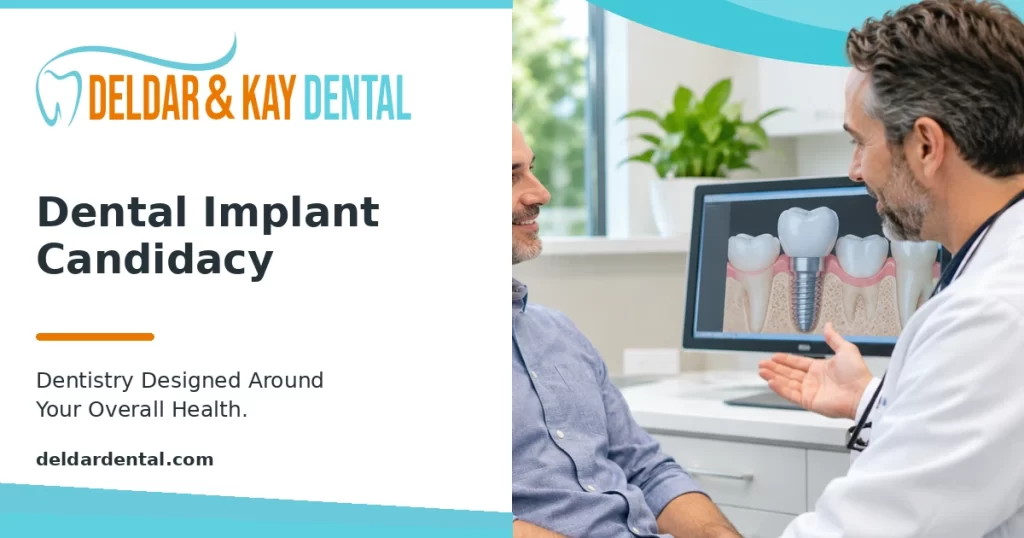
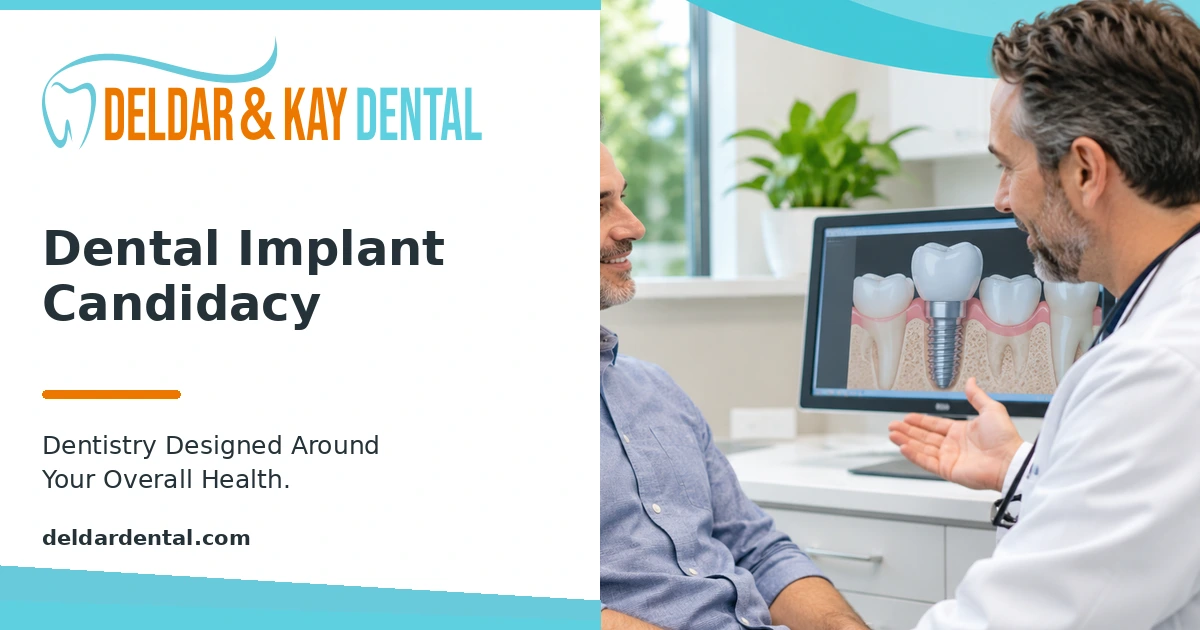
A dental implant is a device placed into the jawbone to support a replacement tooth or other dental restoration.
Dental implant systems commonly consist of an implant body, a connecting component called an abutment, and a restoration such as a dental crown.
In suitable cases, implants can also support bridges or removable dentures.
Unlike certain traditional bridges, an individual implant-supported crown may replace a missing tooth without requiring the neighboring teeth to support the restoration.
However, this does not mean implants are always preferable to other tooth replacement options.
Every approach has potential advantages, limitations, costs, and maintenance requirements.
Understanding your individual circumstances is essential before deciding which option makes sense for you.
1. The Condition of Your Jawbone
Dental implants rely on the surrounding bone for support.
After a natural tooth is lost, the bone in that area may gradually change because it no longer receives stimulation through the tooth’s root.
The extent of these changes varies.
Your dentist may evaluate the amount, shape, and location of available bone when determining whether implant placement is feasible.
Dental imaging can help assess relevant anatomy, including neighboring teeth, sinus spaces, and nerve locations.
Some patients have adequate bone for implant placement without additional procedures.
Others may require consideration of bone grafting or alternative treatment approaches.
Having experienced bone loss does not automatically mean you cannot receive implants. It does mean that additional planning may be necessary.
2. The Health of Your Gums
Your gums and supporting tissues play an important role in maintaining dental implants.
Untreated periodontal disease can damage the tissues supporting natural teeth and may influence implant treatment planning.
Signs of gum disease can include bleeding, swelling, persistent bad breath, gum recession, and changes in tooth stability.
Some people have periodontal disease without experiencing obvious discomfort.
For this reason, a dental examination is important even if your gums appear healthy to you.
If active periodontal disease is identified, managing the condition may be an important step before implant treatment.
A history of gum disease can also be relevant when determining appropriate long-term maintenance.
Dental implants cannot develop cavities in the same way natural teeth can, but the surrounding tissues remain susceptible to inflammation and disease.
3. Your Medical History and General Health
Dental implant placement involves a healing process.
Your general health may influence how tissues respond and how treatment is planned.
Medical conditions such as diabetes, disorders affecting immune function, and certain bone-related conditions may require additional consideration.
For patients with diabetes, blood glucose management may be relevant to healing and infection risk.
The significance of any particular medical condition depends on individual circumstances.
A diagnosis alone does not necessarily prevent implant treatment.
During your consultation, your dentist may review your medical history, discuss relevant concerns, and recommend coordination with your physician when appropriate.
Being open about your health information allows the dental team to consider potential risks before proceeding.
4. Medications That May Influence Treatment Planning
The medications you take can affect dental procedures in several ways.
Some medications influence blood clotting. Others may affect bone metabolism, immune function, or tissue healing.
Certain medications used for osteoporosis or cancer-related bone conditions may require additional evaluation before implant treatment is considered.
This does not mean that everyone taking these medications is automatically unable to receive dental implants.
The type of medication, its intended use, method of administration, duration of treatment, and individual medical circumstances can all be relevant.
Bring an accurate medication list to your dental consultation, including prescription medicines, over-the-counter products, and supplements.
Never stop or change medication to prepare for dental implant treatment unless instructed by the appropriate prescribing healthcare professional.
5. Tobacco and Nicotine Use
Smoking is a recognized risk factor for complications associated with dental implant treatment.
Tobacco use can affect oral tissues and interfere with processes involved in healing.
It may also increase the risk of gum-related complications around implants.
Patients who smoke may still be evaluated for dental implants, but their risk profile and treatment recommendations may differ.
Information about vaping and other nicotine products should also be shared with the dental team.
Research continues to develop regarding the effects of different nicotine products on oral health and implant outcomes.
If you use tobacco or nicotine, discuss your circumstances openly with your dentist.
Your healthcare providers may be able to help you explore strategies for reducing or stopping use, which can have benefits extending beyond dental health.
6. Teeth Grinding and Bite Forces
Dental implants must function within your existing chewing system.
The forces placed on an implant-supported restoration can influence treatment design and long-term maintenance.
People who regularly grind or clench their teeth may place additional stress on dental restorations.
Potential complications can include chipped restorative materials, loosened components, or other mechanical problems.
The presence of grinding does not automatically rule out implant treatment.
However, signs of tooth wear, muscle discomfort, previous restoration fractures, and other findings may be relevant during planning.
Your dentist may evaluate how your teeth contact each other and whether additional protective measures should be considered.
In some cases, an appropriately designed protective appliance may form part of the treatment plan.
7. The Location and Number of Missing Teeth
Implant treatment can look very different depending on which teeth are missing.
Replacing one front tooth involves aesthetic considerations that may differ from replacing a back tooth used primarily for chewing.
A patient missing several adjacent teeth may have different options from someone missing teeth in several separate areas.
Implant-supported crowns, bridges, or dentures may be considered depending on available bone, oral health, anatomy, treatment objectives, and finances.
Not every missing tooth necessarily requires its own implant.
The number and position of implants should reflect the planned restoration and the clinical requirements for support.
This is one reason why implant treatment planning should consider the final restoration from the beginning rather than focusing solely on placing an implant into an available space.
8. How Long the Tooth Has Been Missing
Whether a tooth was lost recently or many years ago can influence the condition of the surrounding area.
Following tooth loss, supporting bone may gradually change.
Neighboring teeth may also shift into the space, while an opposing tooth may move into an area where it no longer has normal contact.
These changes do not happen to the same extent in everyone.
Patients who have lived with a missing tooth for several years may still have appropriate replacement options.
However, additional evaluation may be required to determine whether enough space and supporting bone remain.
If a natural tooth has not yet been removed, treatment planning may also include discussion of whether it can reasonably be retained.
Preserving a natural tooth may be preferable when it remains treatable and has a reasonable prognosis.
An implant is a tooth replacement option, not an automatic reason to remove a tooth that could otherwise be maintained.
9. Your Ability to Maintain Daily Oral Hygiene
Dental implants require consistent care.
Although implant restorations do not experience tooth decay, plaque can accumulate around them.
Inflammation affecting the soft tissues surrounding an implant is known as peri-implant mucositis.
A more advanced inflammatory condition involving loss of supporting bone is known as peri-implantitis.
These conditions can threaten implant health and require appropriate management.
Daily brushing and cleaning around implant restorations are important preventive measures.
Depending on the restoration design, your dentist or dental hygienist may recommend interdental brushes, flossing aids, or other cleaning methods.
The recommended tools should be selected according to your needs and the design of your restoration.
Regular professional examinations and maintenance appointments also help monitor the surrounding tissues.
Before proceeding with implant treatment, it is useful to understand the ongoing care required.
10. Your Expectations, Timeline and Financial Considerations
Dental implant treatment can involve several stages.
Depending on the individual situation, these may include initial evaluation, imaging, management of existing dental disease, tooth extraction, bone preparation, implant placement, healing, and placement of the final restoration.
Some stages may be combined in appropriate cases.
Others may require separate appointments and healing periods.
The overall timeline varies considerably.
Patients should understand what temporary tooth replacement options may be available during treatment and what limitations may apply while healing.
Costs can also vary depending on the complexity of the case, additional procedures, restoration type, and ongoing maintenance requirements.
Discussing treatment fees and alternatives before starting can help you make a decision that reflects your dental needs and personal circumstances.
Dental implant treatment should not be based on promises of permanent, maintenance-free results.
What Happens During a Dental Implant Consultation?
A consultation is intended to gather information and help determine appropriate treatment options.
Your dentist may ask why you are interested in replacing missing teeth and whether you have experienced discomfort, difficulty chewing, or concerns about your smile.
A dental examination can help assess existing teeth, gums, restorations, bite relationships, and the area where teeth are missing.
Appropriate imaging may be recommended to evaluate structures that cannot be fully assessed through visual examination alone.
Your medical and dental history will also provide important context.
Once the relevant information has been collected, your dentist can discuss whether implant treatment is appropriate, whether further evaluation is needed, and what alternatives are available.
You should have an opportunity to ask questions before making decisions.
What If Dental Implants Are Not the Right Option for Me?
Not everyone who wants dental implants will be an appropriate candidate at a particular time.
Some individuals may benefit from addressing gum disease, medical risk factors, or other dental problems before reconsidering implant placement.
Others may find that a different tooth replacement option better fits their circumstances.
Depending on your oral health and treatment objectives, alternatives may include a traditional dental bridge, a removable partial denture, or a complete denture.
Each approach has considerations involving comfort, function, maintenance, cost, and the condition of remaining teeth.
Choosing an alternative does not represent a failure.
The most appropriate treatment is the one that reasonably addresses your needs while taking into account the relevant risks, benefits, and limitations.
How Long Can Dental Implants Last?
Dental implants can provide long-term tooth replacement for many appropriately selected patients.
However, no fixed lifespan can be guaranteed.
The condition of surrounding tissues, daily oral hygiene, smoking, medical conditions, bite forces, and maintenance visits can influence outcomes.
The implant body and the restoration attached to it are also separate components.
A crown, bridge, attachment, or other restorative component may require repair or replacement even when the supporting implant remains functional.
Regular dental appointments provide an opportunity to assess implant health and identify potential concerns.
Understanding that implants require ongoing care is important when evaluating their long-term value.
Frequently Asked Questions
Am I too old to receive dental implants?
Age alone generally does not determine candidacy. Overall health, oral health, healing considerations, anatomy, and individual treatment needs are important factors.
Can I receive dental implants if I have diabetes?
Some individuals with diabetes may be appropriate candidates. Blood glucose management, medical history, oral health, and individual healing considerations may influence treatment planning.
Can I get dental implants after losing a tooth many years ago?
Possibly. Dental imaging and examination can help determine the amount of available bone, tooth replacement space, and other relevant anatomical considerations.
Do I need bone grafting before receiving dental implants?
Not everyone requires bone grafting. The need depends on available bone, the location of the proposed implant, and the planned restoration.
Can I receive implants if I grind my teeth?
Grinding does not necessarily prevent implant treatment. Your dentist may consider bite forces, restoration design, and appropriate protective measures when planning care.
Can dental implants fail?
Yes. Implant treatment carries potential risks, including infection, failure to integrate with bone, tissue complications, and mechanical problems.
How do I find out whether implants are right for me?
A dental consultation involving examination, relevant medical history, and appropriate imaging can help determine whether implants or another tooth replacement option may be suitable.
Explore Dental Implant Options at Deldar & Kay Dental
Replacing missing teeth is a personal decision that should reflect your oral health, functional needs, general health, and individual priorities.
At Deldar & Kay Dental in Noblesville, Dr. Mike Deldar and Dr. John Kay take an overall-health focused approach to dental care, helping patients understand the considerations that influence treatment options.
Whether you are missing one tooth, several teeth, or exploring alternatives to an existing removable restoration, a consultation can help clarify your next steps.
The practice welcomes patients from Noblesville, Carmel, Fishers, Westfield, Indianapolis, Lapel, and surrounding Hamilton County communities.
Deldar & Kay Dental
Dentistry Designed Around Your Overall Health.
14753 Hazel Dell Crossing, Suite 700
Noblesville, IN 46062
Call: (317) 208-0000
Website: https://deldardental.com/
Dental implant suitability, healing, treatment timelines, and outcomes vary by individual. An examination is necessary to establish appropriate treatment recommendations.