Losing a tooth can be an unexpected and sometimes emotional experience.
Whether tooth loss occurs because of decay, gum disease, an injury, or a tooth that could no longer be maintained, the resulting changes can influence several aspects of daily life.
You may notice that chewing certain foods becomes more difficult. You might feel self-conscious when smiling or speaking. Perhaps you have started chewing primarily on one side of your mouth.
For individuals missing several teeth, these challenges may become more noticeable.
Fortunately, modern dentistry offers several approaches to replacing missing teeth.
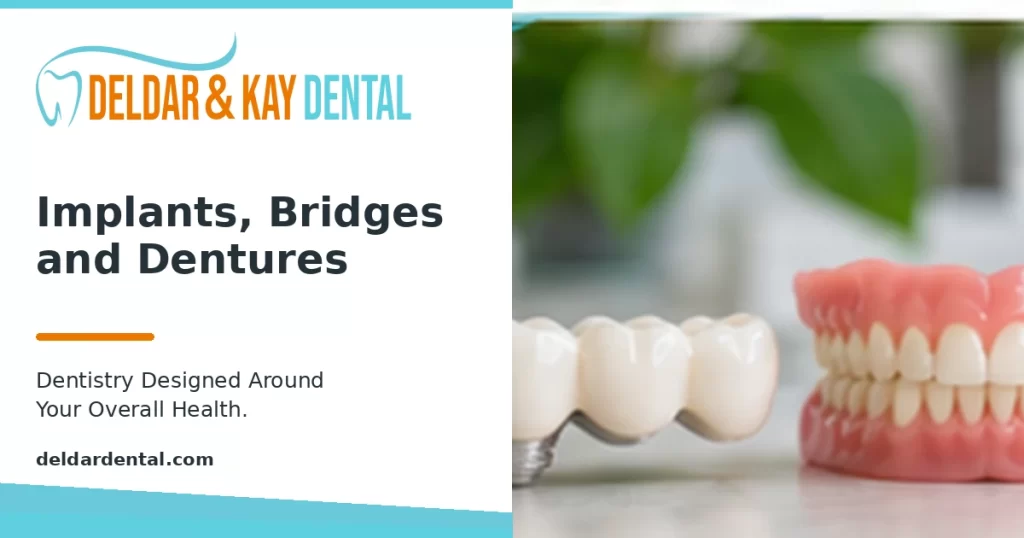
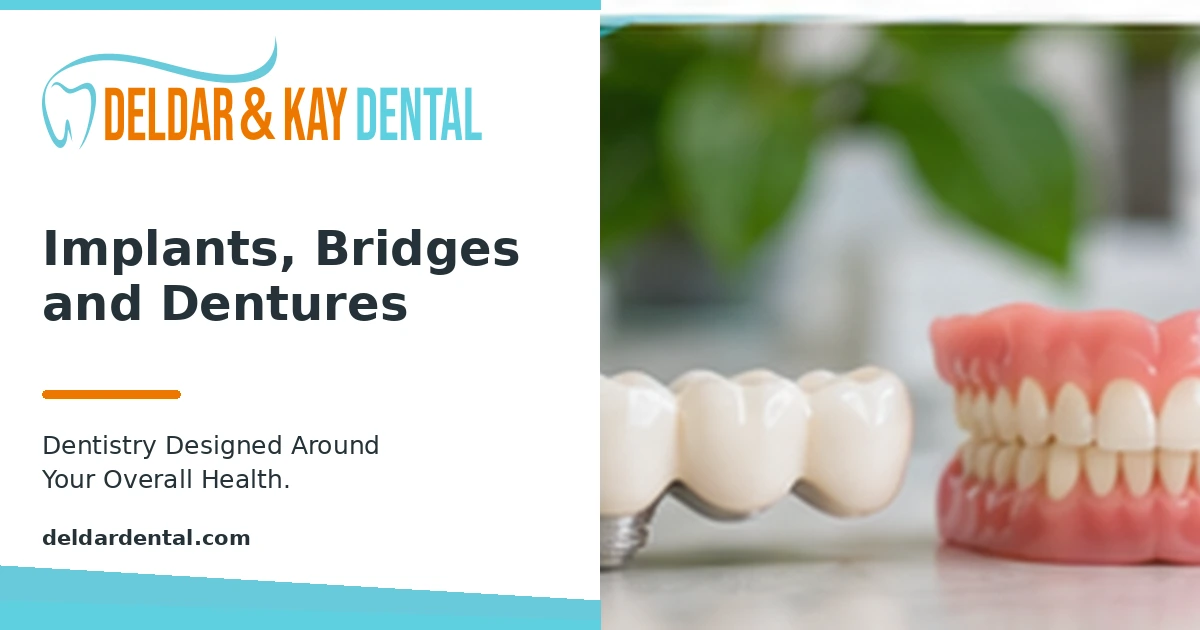
Dental implants, traditional dental bridges, and removable dentures each have potential advantages, limitations, and maintenance requirements.
At Deldar & Kay Dental in Noblesville, Indiana, Dr. Mike Deldar and Dr. John Kay consider tooth replacement within the broader context of oral health, function, and overall wellness.
Understanding your options can help you prepare for an informed discussion about which treatment may be appropriate for your individual circumstances.
Why Replacing Missing Teeth May Be Important
Teeth contribute to more than the appearance of your smile.
They help you chew food, support certain speech sounds, and maintain relationships between neighboring and opposing teeth.
When a tooth is lost, the surrounding oral environment may gradually change.
Neighboring teeth can sometimes shift toward the empty space. An opposing tooth may move into an area where it no longer has normal contact.
The supporting jawbone may also undergo changes following tooth loss.
These changes do not occur at the same rate or to the same extent in everyone.
The location of the missing tooth, the condition of surrounding teeth, bite relationships, and existing oral health can influence the consequences of tooth loss.
Not every missing tooth requires replacement in every situation.
A dental evaluation can help determine whether replacement is advisable and which approach may be appropriate.
What Happens to the Jawbone After Tooth Loss?
Natural tooth roots interact with the surrounding bone during normal function.
When a tooth is removed, the bone in that area may gradually remodel and decrease in volume.
This process can be particularly relevant when planning future dental implant treatment.
The amount of bone change varies according to individual anatomy, healing, the reason for tooth loss, and other factors.
Patients who have been missing teeth for several years may require additional evaluation before implant placement can be considered.
However, a history of bone loss does not automatically eliminate implant treatment as an option.
Dental imaging can provide information about the amount and location of available bone.
In some cases, additional procedures or alternative restorative approaches may be considered.
Option 1: Dental Implants
A dental implant is a device placed into the jawbone to support a dental restoration.
An individual implant-supported tooth replacement generally includes three components:
- The implant body placed within the jawbone.
- An abutment connecting the implant to the restoration.
- A dental crown that replaces the visible portion of the missing tooth.
Dental implants may also support bridges or dentures when multiple teeth are missing.
The appropriate number and position of implants depend on the planned restoration, available bone, oral health, and individual treatment objectives.
Implant treatment typically involves a planning process and a period of healing.
The implant must establish an appropriate relationship with the surrounding bone before it can reliably support the intended restoration.
Treatment timelines vary considerably.
Potential Advantages of Dental Implants
For appropriately selected patients, dental implants may offer several benefits.
An individual implant-supported crown may replace a missing tooth without requiring neighboring teeth to be prepared as supports.
Implants can provide support for fixed restorations or help stabilize certain removable dentures.
Because implants interact with the surrounding jawbone, they may help maintain bone in the area where they are placed, although they do not eliminate all future bone changes.
Implant-supported restorations may also help restore chewing function in suitable cases.
However, these potential advantages should be evaluated alongside the patient’s clinical circumstances.
Dental implants are not automatically the best choice for every missing tooth.
Potential Limitations of Dental Implants
Implant treatment involves clinical procedures and healing requirements that may not be appropriate for everyone.
The condition of the jawbone and gums, medical history, medication use, tobacco exposure, and other factors may influence suitability.
Additional procedures may be necessary in some cases.
Potential risks include infection, injury to surrounding structures, failure of the implant to integrate with bone, and complications involving supporting tissues or restorative components.
Implants also require ongoing maintenance.
Although implant restorations cannot develop cavities, plaque can accumulate around them and contribute to inflammation.
The surrounding tissues remain susceptible to disease.
Patients considering implants should understand the potential costs, treatment stages, healing requirements, and long-term responsibilities.
Option 2: Traditional Dental Bridges
A traditional dental bridge is a fixed restoration used to replace one or more missing teeth.
It typically uses neighboring teeth as supports for an artificial replacement tooth.
The supporting teeth are generally prepared to accommodate crowns connected to the replacement tooth.
The bridge is then secured in position.
Because a traditional bridge is fixed, patients do not normally remove it during daily activities.
Bridges may be appropriate in situations where neighboring teeth can provide adequate support.
They may also be considered when implant treatment is not suitable or when a patient prefers a different approach.
Potential Advantages of Dental Bridges
A traditional bridge can replace a missing tooth without placing an implant into the jawbone.
Treatment may involve a different timeline from implant therapy because there is no implant integration period.
For patients whose neighboring teeth already require crowns, a bridge may sometimes be a reasonable restorative option.
A fixed bridge may also provide functional and aesthetic benefits, depending on the individual situation.
Patients who prefer a fixed restoration but are not appropriate candidates for implants may wish to discuss this approach.
The suitability of a bridge depends on the health and structural condition of the supporting teeth.
Potential Limitations of Dental Bridges
Traditional bridges generally require preparation of neighboring teeth.
This may involve removing some tooth structure to accommodate supporting crowns.
If neighboring teeth are otherwise healthy, this consideration may influence the decision between a bridge and an implant-supported restoration.
Supporting teeth remain susceptible to decay, gum disease, and other dental problems.
If a supporting tooth becomes compromised, the entire bridge may be affected.
Cleaning beneath the replacement tooth also requires appropriate techniques.
Your dental team may recommend floss threaders, interdental cleaning tools, or other methods suited to the restoration.
A bridge does not replace the missing tooth root within the jawbone.
Consequently, bone changes in the area beneath the replacement tooth may continue.
Option 3: Removable Partial Dentures
A removable partial denture is designed to replace one or more missing teeth while some natural teeth remain.
Depending on its design, it may use remaining teeth and oral tissues for support.
Partial dentures can be made using different materials and attachment systems.
They are removed for cleaning and according to the instructions provided by the dental team.
A removable partial denture may be considered when several teeth are missing in different areas of the mouth.
It may also be appropriate when fixed restorative options are not suitable or when financial considerations influence treatment decisions.
Potential Advantages of Partial Dentures
A partial denture can replace multiple missing teeth with a single removable appliance.
Depending on the design, it may require less extensive preparation of natural teeth than some fixed restorations.
It can also provide a tooth replacement option for patients who are not appropriate candidates for implant treatment.
Initial treatment costs may be lower than those associated with certain implant-supported restorations, although costs vary.
Some partial denture designs can be modified if additional teeth are lost, depending on the appliance and clinical circumstances.
Potential Limitations of Partial Dentures
Removable partial dentures may require an adjustment period.
Some patients initially notice changes in speech, chewing, or oral comfort.
The appliance may place forces on supporting teeth and oral tissues.
Poorly fitting or inadequately maintained dentures can contribute to irritation or other oral health concerns.
Partial dentures must be removed and cleaned according to professional instructions.
The remaining natural teeth also require consistent preventive care.
Changes in the mouth over time may affect appliance fit, potentially requiring adjustments, repairs, or replacement.
Option 4: Complete Dentures
Complete dentures replace all teeth in an upper or lower dental arch.
They generally rest on the oral tissues and rely on their design, fit, and surrounding anatomy for retention and stability.
Upper and lower dentures can behave differently because of differences in anatomy and tongue movement.
Some individuals adapt comfortably to complete dentures, while others experience challenges involving stability, chewing, or comfort.
The degree of adaptation varies.
Complete dentures may be appropriate for individuals who have lost all teeth in an arch and are considering removable tooth replacement.
They may also form part of a broader treatment plan involving future implant-supported options.
Option 5: Implant-Supported Dentures
Implants can sometimes be used to provide additional support or retention for dentures.
An implant-retained overdenture is generally a removable appliance that connects to attachments associated with dental implants.
Other implant-supported restorations may be designed to remain fixed in place.
These approaches differ in design, maintenance requirements, costs, and clinical suitability.
For some patients, implant-supported options may improve denture stability and chewing function compared with conventional removable dentures.
However, the extent of improvement varies.
Adequate bone, oral health, medical considerations, and the ability to maintain the implants and restoration are important factors.
A consultation can help determine which designs, if any, may be appropriate.
Comparing Dental Implants, Bridges and Dentures
There is no single tooth replacement option that is appropriate for every patient.
The following comparison provides a general overview.
| Consideration | Dental implants | Traditional bridges | Removable dentures |
|---|---|---|---|
| Support | Jawbone | Neighboring teeth | Oral tissues and sometimes teeth |
| Removable by patient | Depends on restoration | No | Yes |
| Implant placement procedure | Required | Not required | Not required for conventional dentures |
| Neighboring tooth preparation | Often unnecessary for single implant crowns | Generally required | Depends on design |
| Bone interaction | Implant supported within bone | No replacement root | No replacement root |
| Treatment timeline | May involve several healing stages | Depends on restorative needs | Depends on appliance design |
| Maintenance | Daily cleaning and professional monitoring | Cleaning around and beneath bridge | Appliance and oral tissue cleaning |
| Initial cost | Often higher | Variable | Often lower for conventional designs |
Individual treatment costs and outcomes cannot be determined from a general comparison alone.
Which Tooth Replacement Option Looks Most Natural?
Appearance is an important consideration for many patients.
Modern restorative materials can be used to create tooth replacements that resemble natural teeth.
However, the final appearance depends on several factors, including the condition of surrounding tissues, tooth position, restoration design, and individual anatomy.
Replacing a missing front tooth may involve different aesthetic considerations from replacing a back tooth.
Gum contour and available bone may also influence the appearance of the final restoration.
Dental implants, bridges, and dentures can each provide aesthetic benefits in appropriate circumstances.
No approach can guarantee a particular appearance for every patient.
Discussing your expectations before treatment helps establish realistic objectives.
Which Option Is Best for Chewing?
Chewing function depends on more than the type of restoration used.
The number and location of remaining teeth, bite relationships, jaw function, appliance stability, and individual adaptation all play a role.
Fixed restorations may feel more stable for some patients.
Implant-supported dentures may offer additional retention in appropriate circumstances.
Conventional dentures can also provide useful tooth replacement, although certain foods may be more challenging for some individuals.
Patients should discuss their functional goals during the consultation.
If chewing difficulties have affected dietary variety or nutritional intake, additional guidance from a medical provider or registered dietitian may be appropriate.
How Long Do Tooth Replacement Restorations Last?
Dental implants, bridges, and dentures are not maintenance-free.
Their functional lifespan varies according to oral health, daily habits, materials, bite forces, and professional maintenance.
Implant-supported crowns may require repair or replacement even when the implant itself remains functional.
Bridges may need replacement if supporting teeth develop problems or if restorative materials become damaged.
Dentures may require adjustments or replacement as the oral tissues and supporting structures change.
Regular dental examinations provide opportunities to monitor restorations and identify concerns.
Patients should avoid assuming that any tooth replacement option will last permanently without maintenance.
Understanding the Cost of Replacing Missing Teeth
The cost of tooth replacement depends on individual treatment requirements.
Relevant factors may include:
- The number of missing teeth.
- The type of restoration.
- The condition of supporting teeth and gums.
- Imaging requirements.
- Additional procedures.
- Laboratory work.
- Treatment complexity.
- Long-term maintenance needs.
Dental insurance coverage also varies.
Some plans may cover portions of bridge or denture treatment while providing limited or different coverage for implants.
Before beginning treatment, ask for an individualized estimate and information about anticipated treatment stages.
Consider both initial expenses and potential future maintenance costs.
The lowest initial price may not necessarily represent the most appropriate long-term choice.
What Happens During a Tooth Replacement Consultation?
Your consultation begins with understanding your concerns and treatment goals.
Your dentist may ask when the teeth were lost, whether you experience chewing difficulties, and whether you have previously used a tooth replacement appliance.
An examination can help evaluate your remaining teeth, gum health, available space, bite relationships, and supporting oral structures.
Appropriate dental imaging may provide additional information.
Your medical history and medications may also influence treatment recommendations.
Once the relevant information has been collected, your dentist can explain which options may be suitable and whether additional evaluation is necessary.
You should have an opportunity to discuss costs, timelines, maintenance requirements, and potential limitations before proceeding.
Frequently Asked Questions
Is a dental implant better than a dental bridge?
Not necessarily. Each option has advantages and limitations. The appropriate choice depends on oral health, anatomy, neighboring teeth, medical circumstances, and personal preferences.
Can I replace several missing teeth with dental implants?
Yes, in appropriate circumstances. Implants may support individual crowns, bridges, or dentures.
Does every missing tooth need to be replaced?
No. The need for replacement depends on the location of the missing tooth, oral function, bite relationships, and individual treatment objectives.
Can I get dental implants if I already wear dentures?
Possibly. A dental evaluation can help determine whether implant-supported options may be appropriate.
Are removable dentures less expensive than implants?
Conventional removable dentures often have lower initial costs than implant-supported restorations, but individual fees and maintenance requirements vary.
Can a dental bridge prevent bone loss?
A traditional bridge does not replace the missing tooth root. Bone changes beneath the replacement tooth may continue.
Can dental implants develop gum disease?
The tissues surrounding dental implants can develop inflammatory conditions that may threaten implant health. Daily cleaning and professional monitoring remain important.
What if I have been missing teeth for many years?
You may still have tooth replacement options. Examination and imaging can help determine which approaches are appropriate.
Find the Right Tooth Replacement Option for Your Needs in Noblesville
Missing teeth can affect oral function, appearance, comfort, and daily routines.
Choosing a replacement option should involve careful consideration of your individual circumstances rather than relying on a single recommendation for everyone.
At Deldar & Kay Dental in Noblesville, Dr. Mike Deldar and Dr. John Kay take an overall-health focused approach to dental care.
Whether you are considering dental implants, a traditional bridge, removable dentures, or another restorative option, a consultation can help you understand the potential benefits and limitations of each approach.
The practice welcomes patients from Noblesville, Carmel, Fishers, Westfield, Indianapolis, Lapel, and surrounding Hamilton County communities.
Deldar & Kay Dental
Dentistry Designed Around Your Overall Health.
Visit https://deldardental.com/ to request your tooth replacement consultation.
Treatment suitability, costs, timelines, healing, and outcomes vary according to individual circumstances. An examination is necessary to determine appropriate treatment recommendations.